
Search
Results for
Manufacturing Engineering Technology
This program is not currently accepting new students.
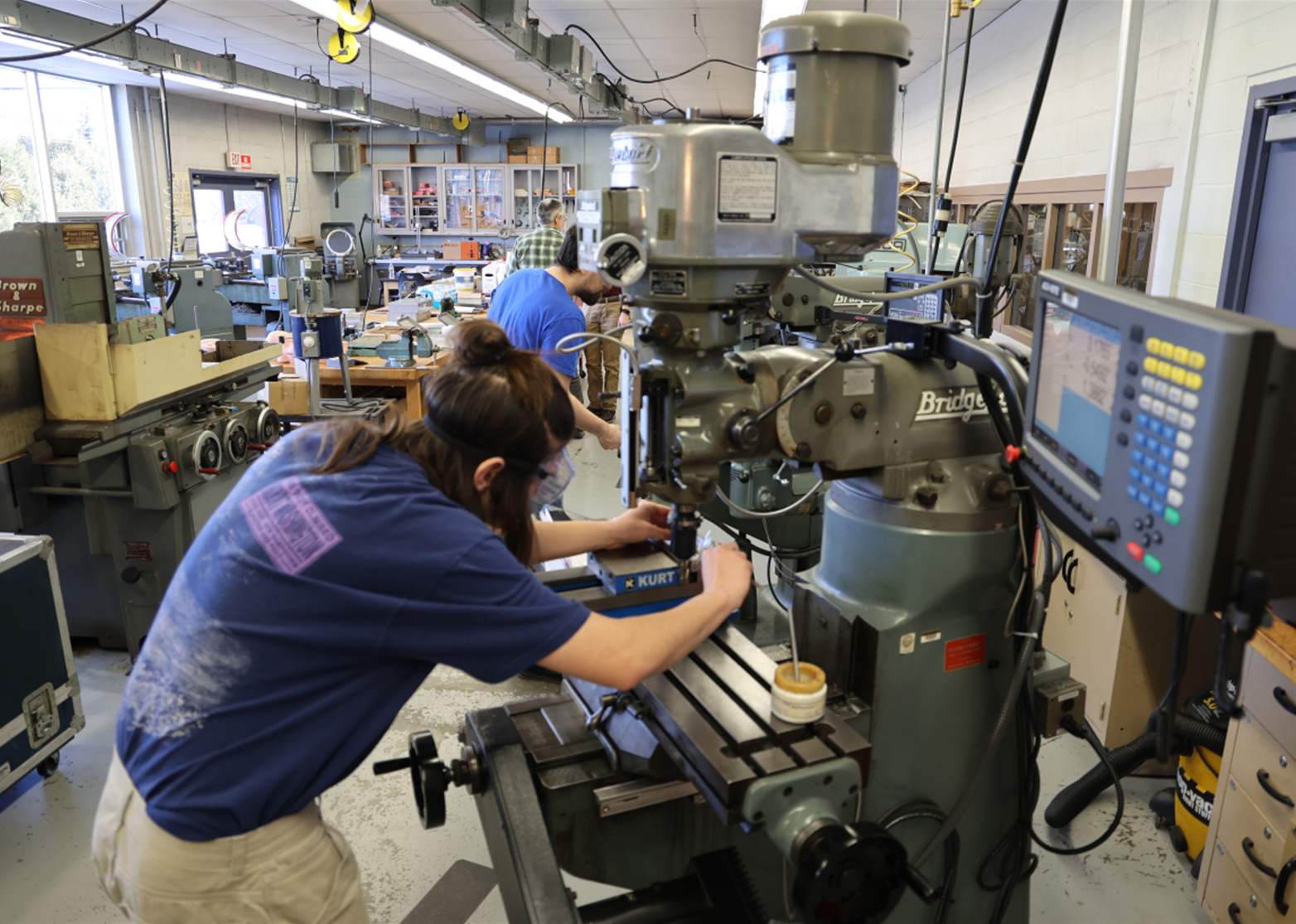 NHTI's Manufacturing Engineering Technology degree program educates you in the manufacturing field, emphasizing mathematics and science courses to give you the knowledge to cope with changing technology. Course work incorporates the theory and practice of manufacturing from planning and layout through the operation and control phases. Extensive computer applications are part of the program, including computer-aided drawing/modeling and automation in manufacturing. English and social sciences are taught to broaden your perspective and improve communication skills.
Do you have questions? Contact Dennis Tappin at dtappin@ccsnh.edu.
Mathematics
This program is not currently accepting new students.
NHTI's Mathematics degree program offers you a rigorous and cost-effective education with small class sizes to form long-lasting connections with peers and professors. You'll gain hands-on experience as a tutor of math and physics in ACE, by competing with our Math Team, and through investigations in our well-equipped physics lab. In your final semester, you'll investigate a topic of your interest in math in collaboration with a faculty member. In your senior project presentation, you'll share your newfound expertise with the academic community.
Do you have questions? Contact Dan Shagena, department chair, at dshagena@ccsnh.edu or 603-271-6484 x4307.
Mechanical Engineering Technology
NHTI's Mechanical Engineering Technology degree program educates you in the mechanical engineering field and includes courses in the areas of design, manufacturing, and controls. Math and physical sciences are emphasized to give you the basic knowledge to cope with changing technology. Course work incorporates theory and practice with extensive computer applications including computer-aided drawing/modeling and design.
Do you have questions? Contact Jeff Beltramo, program coordinator, at jbeltramo@ccsnh.edu. The department chair for this program is Dan Shagena, who can be reached at dshagena@ccsnh.edu.
LXMO201C
Prepares the student to take the national certification examination through the American Registry of Radiologic Technologists. Various topics will be addressed each week with practice registry exam given to complete the program.
LXMO159C
Examines the radiographic positioning of the osseous system. Topics in this course include positioning, radiographic exposure factors, medical terminology, pathology, radiographic anatomy, radiation protection, and special considerations for the pediatric and geriatric patients. The clinical experience is an extension of the classroom where the student will develop the theory into practical skills through instruction, application, critique, and evaluation on common procedures. All students enrolled in in this course will be charged a $500 per semester clinical surcharge.
LXMO103C
Introduces the student to the principles of radiography, radiographic terminology, and radiation protection. This course covers the anatomy and radiographic positioning of the thoracic viscera.
LXMO180C
A basic review of the physical principles of matter, leading to tube production of electricity with its ramifications pertinent to the field of radiologic technology. Basic radiation producing circuitry is discussed including closed circuit television along with digital radiography.
LXMO220C
An understanding of the components, principles, and operation of digital imaging systems found in diagnostic radiology. Factors that impact image acquisition, display, archiving, and retrieval are discussed as well as quality assurance and maintenance.
LXMO116C
A discussion of the principles leading to the production of the manifest image. The general design of the x-ray tube as well as x-ray production and emission. Tube rating charts, factors affecting radiographic quality, grids, and accessories.
LXMO151C
Teaches patient care and safety skills necessary for a LXMO in a hospital setting. Topics covered include hospital organizational structure, ethics, patient assessment, safety, medical emergencies, infection control, asepsis, medical terminology, pharmacology, and venipuncture. Students will learn proper patient communication and care through a variety of lectures and interactive exercises.